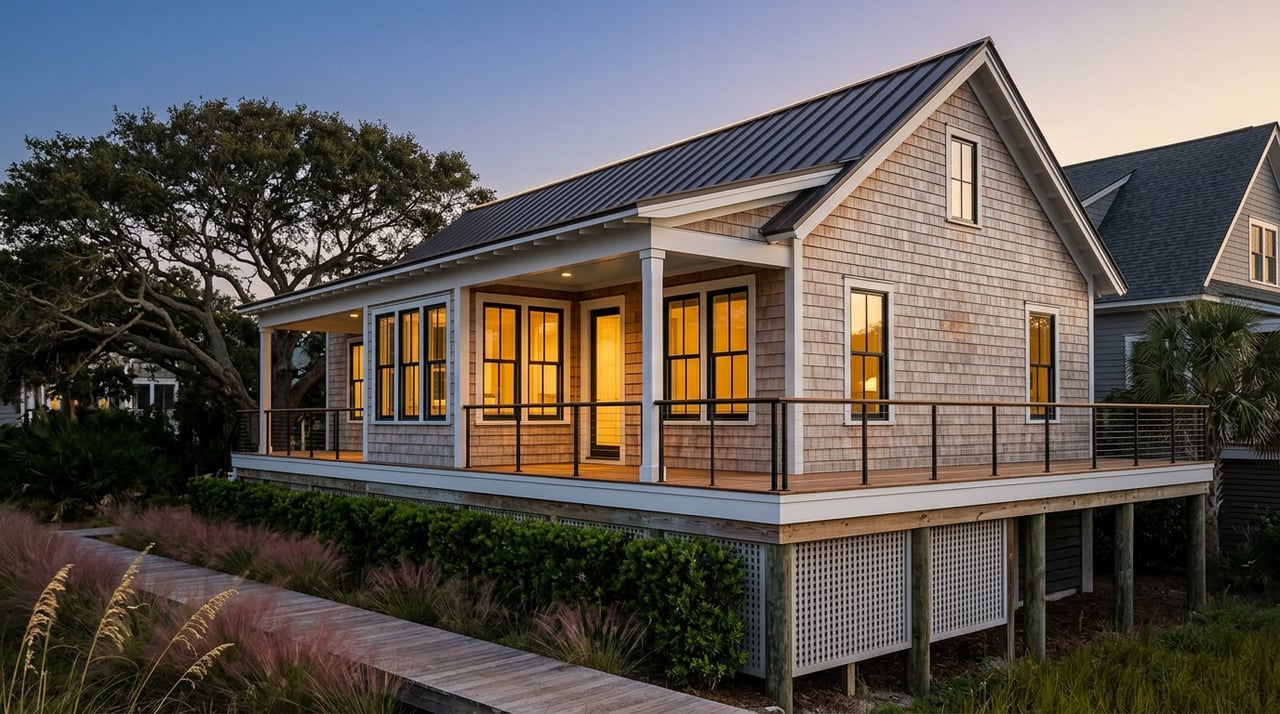
The Short-Term Rental Rule That Resets When You Buy on the NC Coast
September 10, 2026
September 10, 2026
A Raleigh buyer closes on a cottage two blocks off the Wrightsville Beach loop. The listing said "established rental history," six years on Airbnb, a rental calendar the seller happily shared during due diligence. Nothing about the house changes hands differently than any other coastal purchase. But the day title transfers, something the buyer never thought to ask about resets: the house's legal right to be used as a rental.
That is not a hypothetical built for drama. It is how Wrightsville Beach's own development code treats a sale, and it is the kind of detail that never shows up in the generic "is North Carolina Airbnb-friendly" guides that dominate a search for coastal rental rules. Those guides are not wrong. They are just answering the wrong question for a buyer this far along in a transaction.
North Carolina's regulatory posture toward short-term rentals really is light by national standards. There is no statewide rental license. State law caps how far cities and counties can go with certain registration requirements, and the state's Vacation Rental Act generally treats a stay under 90 days for a guest with a permanent residence elsewhere as the category that triggers landlord-tenant style protections around deposits and written agreements.
That is the layer every aggregator article covers, and it is true as far as it goes. What it does not tell a buyer is what happens at the moment of sale, because that question is answered by the town, not the state. North Carolina's approach hands zoning, occupancy standards, and use classifications to local government. Two beach towns on the same coast can run entirely different playbooks, and the playbook that matters most is the one that governs what happens the day you take title.
Wrightsville Beach's Unified Development Ordinance requires a Certificate of Zoning Compliance before land may be used or occupied at all, and its definition of a "use change" is broader than most buyers assume. It includes a change in ownership of the land or the business operating on it. In plain terms, a sale can count as a new use under the code, which means the town's approval of the seller's rental operation does not automatically travel with the deed.
The town's own zoning compliance application backs this up in its fine print: a nonrefundable review fee applies to both new and existing uses, and the paperwork exists precisely because "existing use" is not treated as a permanent, transferable status. Wrightsville Beach's code also states that development approvals attach to the land in writing, which cuts the other way for a careful buyer: what has actually been approved for a parcel matters more than what a seller says it was used for.
None of this means a buyer cannot rent the house. It means the seller's calendar of past bookings is a marketing document, not proof that the buyer inherits the same standing. The rental history is not the asset. The zoning compliance file is.
Contrast that with Emerald Isle, on the western end of Bogue Banks. North Carolina's preemption of certain local permit and registration schemes means Emerald Isle does not run a town-issued short-term rental permit that a sale would revoke. The operating layer there is closer to what the generic guides describe: register the business if you're operating at scale, register with the North Carolina Department of Revenue for sales tax, register separately with Carteret County for occupancy tax, and keep the property up to code on smoke detectors and basic safety items.
A buyer in Emerald Isle still has homework, just a different kind. Zoning still varies by parcel, and a subdivision or condominium regime can carry private restrictions that no amount of state preemption touches. But there is no ownership-triggered compliance review sitting in the code the way there is in Wrightsville Beach. The risk in Emerald Isle is mostly about which tax accounts you open and which HOA documents you read. The risk in Wrightsville Beach includes a live question about whether the town will re-examine the property's approved use once your name is on the deed.
Here is what that difference looks like side by side for a buyer doing pre-offer homework:
| What to verify before closing | Wrightsville Beach | Emerald Isle |
|---|---|---|
| Town-level use approval | Certificate of Zoning Compliance required; ownership change can count as a use change | No town rental permit tied to ownership |
| Fee tied to compliance review | $100 nonrefundable, per the town's application | None at the town level |
| Primary tax registrations | State sales tax, New Hanover County room occupancy tax | State sales tax, Carteret County occupancy tax |
| Where private rules can still override | HOA or condo covenants | HOA, subdivision, or condo covenants |
The lesson is not that one town is better for investors. It is that "the NC coast" is not a single regulatory environment, and treating it as one is how a rental income projection quietly falls apart between contract and closing.
Senate Bill 291, filed in March 2025 by Senators Tim Moffitt, Tom McInnis, and Bobby Hanig, would create statewide guardrails limiting how far cities and counties can go in restricting short-term rentals, including bans on prohibiting the use outright or requiring owner occupancy. If it passed, it would push the state toward the kind of uniform floor that a lot of buyers already assume exists.
It has not passed. As of the most recent legislative tracking available, the bill remains parked in the Senate's Rules and Operations Committee, referred there the same month it was filed, with no floor vote scheduled. Until that changes, or a successor bill moves, the town-by-town patchwork described above is not a temporary quirk. It is the operating reality for anyone closing on coastal property this year.
For a Triangle buyer running the math on a coastal purchase, the practical takeaway is to treat the zoning compliance file as part of due diligence, not an afterthought. Ask for the property's actual Certificate of Zoning Compliance history in towns that use one, not just the seller's booking calendar. Budget for the possibility of a new compliance application and its fee as a closing cost, and build in time for that review before assuming rental income starts on day one of ownership. If the property sits in an HOA or condo association, read the governing documents directly rather than relying on a listing agent's summary of what is "allowed."
The bigger shift in thinking is this: a strong rental history under the previous owner tells you the market wants the house. It does not tell you the town will treat you the same way it treated them. That distinction is the difference between a coastal purchase that performs the way the pro forma says it will and one that starts with an unplanned trip to a planning department.
If I buy a house that's already operating as a short-term rental, do I automatically inherit its rental status? Not in every town. In Wrightsville Beach specifically, the code treats a change in ownership as a potential use change, which can require a new Certificate of Zoning Compliance rather than an automatic transfer of the prior owner's approved use.
Are short-term rentals banned anywhere on the North Carolina coast? Based on the towns covered here, no. Both Wrightsville Beach and Emerald Isle allow short-term rental use. The difference is in the process and paperwork required to operate legally, not whether the use itself is permitted.
Will Senate Bill 291 fix this patchwork if it eventually passes? It would move the state toward more uniform rules limiting what cities and counties can restrict, but as of the most recent tracking it has not advanced past its initial committee referral, so buyers should plan around today's town-by-town rules rather than a future version of the law.
If you're weighing a coastal purchase against equity in a Triangle home, the numbers only work if the rental assumptions hold up under the specific town's rules, not the state's general reputation. Mundra Residential works with Triangle buyers and sellers on exactly this kind of cross-market math, from what a current home is worth to what a coastal purchase actually requires before it can generate income. If a valuation on your Raleigh-area property would help you plan the next move, request a Luxury Home Valuation and start the conversation with real numbers on both sides of the transaction.


Looking to buy, sell, or invest in real estate? We're here to make your dreams a reality! Whether it's finding your perfect home, securing a lucrative investment property, or selling your current one, our dedicated team is ready to guide you every step of the way. Reach out to us today to start your journey towards your real estate goals!